We have weekly meetings that everyone is expected to attend that give us a chance to practice what we're learning, to go deeper in getting to know each other and hear about what each of us is doing and experiencing in our lives. We also use that time to take care of business and address any issues that have come up. That weekly meeting, including having dinner together, usually runs from 6:00-8:30 or 9. So that's 2.5-3 hours.
We share responsibility for cleaning, shopping, etc., which takes about an hour, usually the same or less than we would have to spend on our own place. That brings the weekly total to 3.5 - 4 hours.
The cooking and clean-up can take from 2-3 hours. So that brings the weekly total to between 5.5 and 7 hours.
That’s basically it. For between 5.5 and 7 hours a week, we each enjoy five homecooked meals a week, a happy, clean home, and an engaging learning commuity! That's about the same amount of time most of us would spend on cooking and cleaning alone if we lived elsewhere.
The trainings and support provided by the Common Fire Foundation are free of charge.
 How big are the rooms?
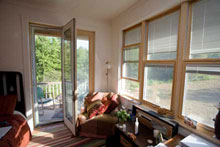
The rooms are medium sized, generally running between 10’x11’ and 10’x16’. All rooms have closets and ten foot high ceilings. There is a large walk-in attic for storage. Every room has direct access to the outdoors.
Are people who live there expected to live or eat a certain way?
The answer is basically no, though there are a few expectations of all residents. The most important of these is that all residents show a commitment to ongoing learning and growing as it relates to helping create a better world.
Some people may feel strongly about certain issues and ways of doing things. They may have to accept that not everyone in the co-op is going to feel the same way, and perhaps never will. But they can expect that other people in the co-op will try to learn from them and understand their views, if not embrace them.
This allows us to honor the fact that nobody has all the answers, all of us have plenty of shortcomings, and we each have a different path to walk. And it gives us the best chance to learn from others who may be doing fabulous work in areas that we ourselves don’t know so much about. And in the process they may learn a lot from us as well.
We prepare shared meals based on what everyone can eat. So shared meals tend to be vegetarian.
It's also important that people don't sit on any issues that come up for them with living in the co-op or with other people. We are very proactive in supporting people addressing issues quickly so they can be addressed and do not grow larger or start to impact people's experience of the co-op.
Who owns the building and land?
A non-profit organization called the Common Fire Foundation owns the land and the building. This means nobody is making a profit and the house will always be maintained as a home for people striving to improve their communities and the world.
 How are decisions made?
We make decisions by consensus. This means all of us must come to agreement before something is decided. It doesn’t mean that what’s decided is exactly what each of us would choose independently. Consensus means all of us get the chance to share our perspectives so the group can come to a decision that works best for everyone. Any one of us can block a decision if we feel we haven’t been understood or if we are fundamentally opposed. Or we can decide to support a decision we don't fully agree with if we feel we have been heard and the others simply believe the proposal being considered is the best way to go.
The Common Fire Foundation has the final say on matters related long-term viability and purpose of the co-op. That means it has the final say on matters related to overall finances, legal issues, the integrity of the building and the land, and anything that might funadamentally shift the purpose of the co-op. It also means that a representative of the Board is involved in all decisions about new applicants and plays an active role any time a major issue arises.
Are children allowed?
Children are most welcome. Parents must consider whether one room is adequate or whether they will need an additional room.
Can the co-op accommodate handicapped people?
The co-op is fairly handicap-friendly. Please contact us for specifics as they may relate to you.
Are pets allowed?
Pets are generally not allowed, primarily to make the space accessable for people with allergies. We have allowed a pet under very specific circumstances, so it is not absolutely out of the question, but you should be aware that it is unlikely.
Do I need to have a car?
The co-op is in a rural area. It's about a 10-minute bike ride to the Village of Tivoli and a 30 minute bike ride to the Town of Red Hook. Neither route has bike lanes and winters are not very kind to bikers. We've had several people live here who did not have cars -- with varying success. For a couple people it worked fine, though they found themselves frequently relying on rides from other people or borrowing other people's cars. For one person it did not work at all and he was extremely frustrated.
How much privacy do people have?
It's up to each person to decide how social they want to be. The two common areas provide lots of space and one of them is almost always available if someone wants a quiet work/study space. And we always have the privacy of our own rooms. Each room also has it’s own private door to the outdoors. Quiet hours are up to the residents, but currently they are from 10pm to 8am.
 How is the guest room used?
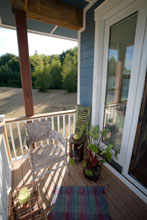
We sometimes make the guest room available for short-term stays for people who need a place to stay and are interested in the co-op lifestyle. The rest of the time it's available for personal guests of the residents and others who are visiting the co-op.
What kind of building is it?
The building is extremely environmentally responsible. In fact, it’s getting a lot of media attention because it’s beind certified as the “Greenest Building in the Eastern US.” It is very efficient with water and energy, and uses safe, nontoxic and sustainable materials.
Is this some kind of religious group?
Nope. We welcome people of all faiths and people who are not religious.
When are applications due?
There’s no set time when the program begins and ends each year. We bring new people in over the course of a year as space and the participants’ life circumstances allow. It’s ideal to have an ongoing flow of new participants joining residents who’ve already been participating for some time, to allow for continuity in the experience of living in the housing co-op, and a sharing forward of knowledge.
Applications are reviewed on an ongoing basis, in large part by the existing residents, so prospective residents can begin the application process at any time.
What's the process for joining? How do I learn more?
First, we ask tha tyou make sure you've read all of the information about the co-op here on the website and that you've skimmed the section about the certificate program. At that point, please give us a call or e-mail.
Among other things, we'll be able to tell you when spaces are opening up in the co-op and get an initial sense of if it seems like a good fit. If it does, then we'll begin a process of getting to know you better and responding to any questions you have, having you visit the co-op (if that's feasible for you), filling out an application, and meeting the current residents.
The current residents along with a representative of the Common Fire Foundation make final decisions by consensus about accepting an applicant.
Turnaround time from when you first contact us to when you get final word can be up to three months. If there's space available and you need to know in a short time-frame, we can sometimes accommodate decisions in as fast as two weeks -- but that's unusual and we make no guarantees!
(845) 554-3406
tivoli@commonfire.org
BEHIND THE SCENES QUESTIONS
How, and where, did you seek out funding for the co-op?
This project benefited tremendously from a major contribution of over $100,000 from the founders who donated most everything they had. That money plus a private loan got us to the point where we were able to buy the land. The land was in turn used as collateral towards securing a construction loan.
Finding anyone who would work with us was very challenging. Finally we found the Cooperative Fund of New England, a non-profit that provides loans to cooperative ventures. They couldn't touch the amount we needed to do the whole job, but they committed to loaning us up to $350,000. That amount, plus their obvious confidence in us was just what we needed to raise the comfort level of our local credit union, the Mid Hudson Valley Federal Credit Union. They committed to loaning the rest of what we projected we would need -- $730,000. Their terms were actually better than the CFNE's so we went with the majority from them and only $230,000 from CFNE.
There are four others key pieces to the puzzle.
New York State Energy Research and Development Authority. Through the New Construction program they provided about $21,000 toward energy efficiency and "green" features of the building, as well as an incentive to pay for our designer/architect and matching funds toward the building modeling and commissioning. Through the PV program, we got about 60% of our solar system paid for. And through the Loan Fund we got an interest rate reduction on our loans through the CFNE and MHVFCU. Specifically the Loan Fund bought down our interest rate by 4% for ten years. The value of that will approach $100,000.
Sponsorships. We benefited tremendously from donations and discounts on products and labor from people who supported our vision. And we reserved 10 official "sponsorships" for companies that stepped up and made significant donations (multiple thousands of dollars or more) in exchange for heightened attention on our website, in news releases, etc.
Sale of Land. We sold two lots contiguous to the one we built on (after subdividing). We put official deed restrictions on them that they have to build green and most of the land needs to be left undisturbed. This attracted the kind of people who are generally interested in living sustainably themselves, and gave us an important infusion of cash.
Donations. Of course everything went over budget, even more than the buffer we had included. So we had to do a LOT of fundraising from individuals. And they really came through for us, to the tune of more than $100,000.
At this point the co-op is self-funding with the residents sharing the cost of covering the monthly mortgage payments and repairs.
How did you assemble the requisite contractors and builders to attain a "green" building?
The most critical step was finding the right initial partners. Once they were in place everything else came relatively easily. We were blessed to have a good friend and committed colleague (Jesse Selman of Small Farm Builders) who was not only competent to be a foreman for the crew and active participant in the design process, but also helped us find the two other critical people in the process.
One was the designer, Chuck Silver of Hudson River Design. He is super knowledgeable and deeply experienced in green building. We hadn't originally planned to pay someone to design the building for us. Design/architect costs are significant. We decided to pay more for someone with a lot of experience as opposed to a couple people who were excited about the project but inexperienced. It was absolutely the right call for us and made all the difference -- saving us a lot of time (which was an intensely scarce commodity throughout the process) and allowed us to take the project to a higher level than we had ever originally imagined.
The other person was the construction manager, Doug Hoffman of Eco-Con Building systems. He was not very experienced with green building, and in fact had never constructed a whole building before. But he had a broad range of construction experience, a powerful desire to have the focus of Eco-Con be green building, and he had some of the basic management skills we needed. And perhaps most importantly, he had a real passion for the project and was ready to have tough conversations. Early discussions about money and salary, etc., gave us a good sense of who he was and how we would be able to communicate with him as we faced challenges throughout the project.
Certainly we at Common Fire did a lot of research ourselves, but with the right people on board in these key positions we were always able to identify and connect with the other necessary people/companies we needed along the way.
Who are the contractors and builders?
All of the materials we used are listed on the "Details for Builders" page, and a few of the significant contractors that we recommend are on there as well at the bottom of the page.
What was the timeline between the original conception of the idea for building and completion of the building?
Broadly speaking there was about a year+ from concept to securing land, another year of design and getting all the permits, etc. lined up, and a year+ of construction. So about 3.5 years.



 What Else Do You
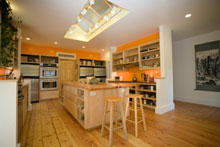 Sunday through Thursday we rotate in pairs who is responsible for cooking dinner. (That means we each cook dinner once a week and it's prepared for us by others four nights each week.) While co-opers end up sitting down and eating together frequently, we're only required to all eat together once a week on meeting night.